June 3, 2025

Since Executive Director Dr. Brendan Wiltse and Lake George Waterkeeper Chris Navitsky visited Albany on May 6, several new legislators have co-sponsored Road Salt Reduction Bill 4481-A. This Assembly bill would establish the Road Salt Reduction Council and the New York Road Salt Reduction Advisory Committee, which would build off – at the state level – previous recommendations from the Adirondack Road Salt Reduction Task Force. We want to extend a huge thank you to all of the new co-sponsors of A.4481-A since we visited the Capitol, especially our local representative Assemblyman Matt Simpson. Passing this bill is a crucial next step to ensure that the entire New York State drinking water supply and freshwater ecosystems – including Lake George and the Adirondack Park – are kept clear and clean for years to come. We have until June 12 to urge additional New York State legislators to pass the Road Salt Reduction Act. Click the link below to take action and support this effort – it takes just 1 minute!
Act now by clicking here and read our letter of support.
***
October 13, 2024

Bryozoans Spotted in Glass Lake (and Lake George)
Good news on sighting of Bryozoas in lake ( not dinosaurs) . Our own scuba diver Barry has seen these creatures in our lake..they help keep our lake waters clean.
Bryozoans (pronounced brahy-uh-zoh-uhns) are tiny animals that form gelatinous-looking colonies in clean water, attaching to stationary objects beneath the water’s surface. And there they remain, thousands of them, eating bacteria, algae, and smaller invertebrates as their tenacles filter and further clarify the water, according to Dr. Allison Hrycik of The Jefferson Project. “They are natural and native,” she says, “and they associate with clear water areas.”
***
October 3, 2024 – As Fall graces us with beautiful colors and crisp air and its bountiful gifts of leaves!
Just a reminder- no raking your leaves in the lake please!
Here is why:
1) it reduces oxygen levels, killing fish.
2) promotes algae growth.
3) adds unwanted nutrients which feed weed growth
4) adds to the “Icky-factor” and burdens neighbors with unwanted clean-up.
5) can cause impairment to the dam system, such as clogging culverts or the valve gate.
6) NYSDEC monitors our lake and dam and could issue fines for poor maintenance
If you have landscapers please remind them also! Remind your neighbors!
Everyone, who lives on Glass Lake and those who use it benefits from our continuing stewardship
***
Read more: Water Quality

May 17, 2024 – Hello GLPC members and Lake owners. We have an opportunity to be active participants in assessment and maintenance of our Glass Lake Waters by becoming part of the Citizen Statewide Lake Assessment Program ( CSLAP) . The Lake data can help us make informed decisions on how to manage our lake to provide for fishing, recreation and beauty. Please read further and send your inquiry to Megan.Myers.RenscoSWCD@gmail.com
The Citizens Statewide Lake Assessment Program (CSLAP) is a volunteer lake monitoring program run by the NYS Department of Environmental Conservation (NYSDEC) and the NYS Federation of Lake Associations, Inc. (NYSFOLA). Projects in Rensselaer County are in partnership with the Rensselaer County Soil and Water Conservation District (RCSWCD). The 2024 sampling project is targeting open water bodies within Environmental Justice areas mapped by the US EPA.
On Thursday June 6th, these organizations will be offering free training in the field to deliver high quality data to DEC. Free lunch will be provided and a Certificate of Attendance will be available.
The training is for a volunteer lake monitoring program. Volunteers are trained in approved sampling methods. Trained CSLAP volunteers collect lake data following a consistent, reproducible way using the same equipment, approved sampling procedures, and laboratories.
Training is offered to interested, committed members of Rensselaer County Lake Associations and Fish and Game Clubs. Any TU HomeWaters members or members associated with the RCCA that are interested in participating in the training should contact Megan Myers of the RCSWCD at Megan.Myers.RenscoSWCD@gmail.com. Please make contact by or before May 24th, if you are interested.
***

November 12, 2021:

November 5, 2021
As you’re wrapping up your fall yard work, please remember to rake or blow your leaves away from the lake and not into it.
It is inevitable that some leaves will naturally fall into the lake, however, an abundance of decomposing leaves will increase the nutrient levels in the lake which can lead to algae blooms and greater aquatic weed growth near your property. As an overabundance of algae and weeds die, they decay, causing bacteria to use up the oxygen in the water. This can kill fish and other aquatic life. Source: https://hopatconglakeregionalnews.com/index.php/news/lake-information/2302-don-t-rake-leaves-into-the-lake
Also see Lake George Association position on this and other fall protective measures re: your yard and lake: https://www.lakegeorgeassociation.org/news-release/a-few-questions-about-your-yard-and-lake-protective-fall-yard-care/
Leaves are a seasonal pain in the neck but we need to think of our beautiful lake, long term.
Mulch them into the lawn, compost them or take them to the Town of Sand Lake Department of Public Works off Thais Road. Hours: M-F 7 AM – 3 PM
—
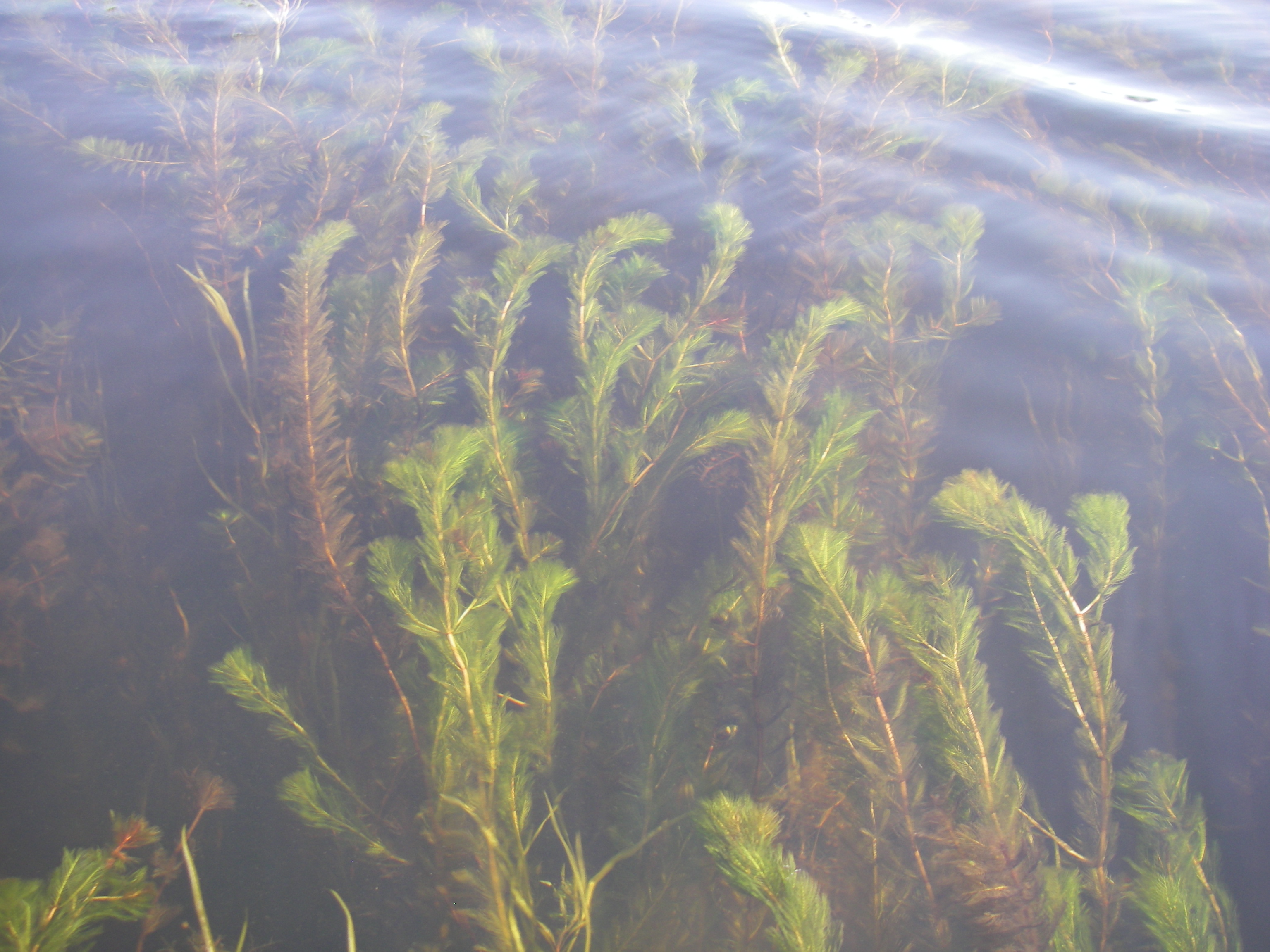
For more information on recent milfoil treatment (completed August 11, 2021), see https://glasslake.org/events/.
—
Lake George Association November 2020 newsletter:

Investigating Harmful Algal Bloom On LG:
|
The follow-up and initial identification was all done by the LGA’s Kristen Wilde, whose family has lived on the Lake for generations.The LGA sounded the alarm, and marshaled the resources needed to investigate the bloom quickly. |


Glass Lake 2018 CSLAP
[Citizens Statewide Lake Assessment Program Report]
https://nysfola.org/wp-content/uploads/CSLAP/cslrpt18glassl.pdf
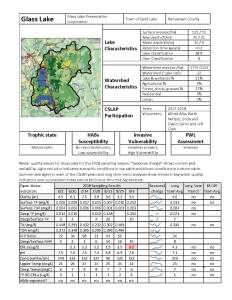
Glass Lake 2017 CSLAP
https://nysfola.org/wp-content/uploads/CSLAP/GlassL_2017CSLAPReport.pdf
For Rensselaer County Water Reports visit DEC site (click here).
June 2018
Common Aquatic Invasive Species of NY
- This Department of Environmental Conservation [DEC] chart contains some of the more common aquatic invasive species found in New York, the areas of the state they currently inhabit, and the control strategy recommended to ensure that they are not spread to new waters via boating and fishing equipment.
- For more detailed information visit A Field Guide of Aquatic Plant Species Found in New York Lakes along with Potential Exotic Invaders.
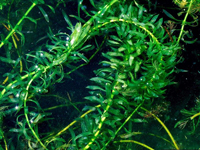
Brazilian Elodea stems have numerous branches and can grow over 20 ft. in length. Is often confused with hydrilla and native elodea. Lance-shaped leaves are about 1/8 inches wide and 1.5 inches long and often have very minute teeth along the edges that may require magnification to see. Leaves are arranged in whorls around the stem with each whorl composed of 4 to 6 leaves. The number of leaves per whorls doubles or triples every 8 to 12 nodes. These “double nodes” are the only place where branches occur along the stem.

Brittle Naiad leaves are opposite (in pairs along the stem), but sometimes appear to be in a whorl at the tip. Leaves are 1-2 inches long, toothed, stiff and pointed. Plant is very brittle and easily breaks into pieces.

Curly-leaf Pondweed stems are branched and somewhat flattened. Leaves are reddish-brown in color, oblong and about 3 inches long. Leaves are usually stiff and crinkled and unlike other pondweeds have finely toothed edges.

European Frogbit floating leaves are heart-shaped and 1-2 inches wide. They resemble the leaves of a miniature waterlily, veined on top and dark purplish red with a spongy coating on the underside. The plant has numerous roots up to 12 inches in length that float freely under the plant.

Eurasian Watermilfoil stems are usually 3 to 10 feet in length and can range from pale pink to reddish brown in color. Bright green feathery leaves are finely divided and occur in whorls (circles) around the stem. Each leaf has 12-21 leaflet pairs. Native northern watermilfoil which it can commonly be confused with has 5-10 leaflet pairs.

Fanwort stems are long and appear tubular. Leaves are fan-like with a short stem and are arranged opposite each other on the stem. Plants have white to light pink flowers that float on the surface.
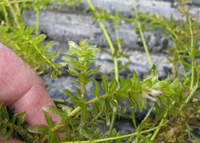
Hydrilla plants looks very similar to Brazilian elodea and other native Elodeas. Northern plants often lack the spiny underleaf and finely toothed leaves may be difficult to see. Best distinguishing characteristic is the turion or bulb connected to its roots that the other plants lack.
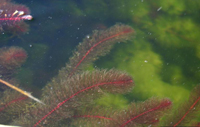
Variable Leaf Milfoil leaves are similar to Eurasian watermilfoil except each leaf has 5-14 leaflets. As the stem reaches the surface it changes its growth pattern to become a stout emergent flower-spike carrying an entirely different type of leaf. These emergent leaves are stalkless, wedge-shaped, stiff, and pointed, with variably-toothed margins.

Water Chestnut stems are very flexible and can reach 12 to 15 ft. in length. On the waters surface the plant contains a circular cluster of saw-toothed edged, triangular floating leaves that are connected to an inflated petiole (bladder) that provides added floatation. Feather-like leaves can be found along the submerged stem. Fruit is a nut with four 1/2 inch barbed spines.

Parrot Feather woody stems can grow over 5 feet in length, often extending outward onto the bank or shore. Emergent leaves are bright blue-green, rigid and deeply serrated. Leaves are arranged in whorls of 4-6 around the stem, with each leaf containing 10-18 segments. The leaves can extend 12″ out of the water and look like miniature fir trees. The underwater leaves are red-brown in color and have 20-30 segments per leaf. They appear to be decaying and are often confused with Eurasian watermilfoil leaves.
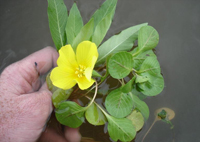
Creeping Water Primrose leaves are willow-like and are alternately arranged on hollow red stems. Young leaves may be rounded. Has bright yellow flowers from spring – fall. Sprawling growth habit that forms dense mats.
***
June 2017
Water Quality Committee
We have an active Water Quality Committee in place which is collaborating with the New York State Federation of Lake Associations [NYSFOLA] and the DEC to monitor the quality of the water in Glass Lake. Members of this committee – Dave and Linda Cairns; Barth Neitzel; Jeff Clark and Al Aita have recently completed a full days training in Hamilton, NY on how to collect and handle water specimens taken at different lake depths so they can then be sent on to the DEC for analyses. This information and its interpretation will then be sent to us.
June 17, 2017 was the second day for collecting samples, which are taken every 2 weeks for 10 weeks during the summer months with a 5 year commitment. As such we owe these individuals a round of thanks for the time they have already put into this and to their long term commitment to this program.
Their efforts highlight for us the stewardship responsibility that we all have for our lake, and the need to avoid any possible pollution.
At the Annual Meeting of June 17, 2017, the membership discussed the issue of inadvertent oil and gas spills, and the importance of not putting any foreign objects into the lake.
Diet for a Small Lake – Written in 2009 as part of a collaboration between the DEC Division of Water and the New York State Federation of Lake Associations, the second edition of Diet for a Small Lake is a significantly updated version of the 1990 publication sharing the same name. HTML version
 Glass Lake Preservation Corporation